


Adjectives are words that modify nouns and pronouns. They are important parts of speech that you likely use in everyday speech and writing without even knowing you are doing so. Grammatically speaking, sentences that don’t contain adjectives are often boring, nondescript, and may even be confusing due to the missing information that adjectives provide.
This article reviews the definition of the various types of adjectives you can use, provides examples of each, and even offers a worksheet to practice upon.
Learn more about what an adjective is and why they are so important to use when you have something important to share with your audience.
What Are Adjectives? Our Adjective Definition
So what is an adjective, exactly? In order to answer this question, you can’t just make a long list of adjectival words since it would be impossibly long. Let’s take a look at the many examples of adjective types so you can recognize their use and apply it to your own material.
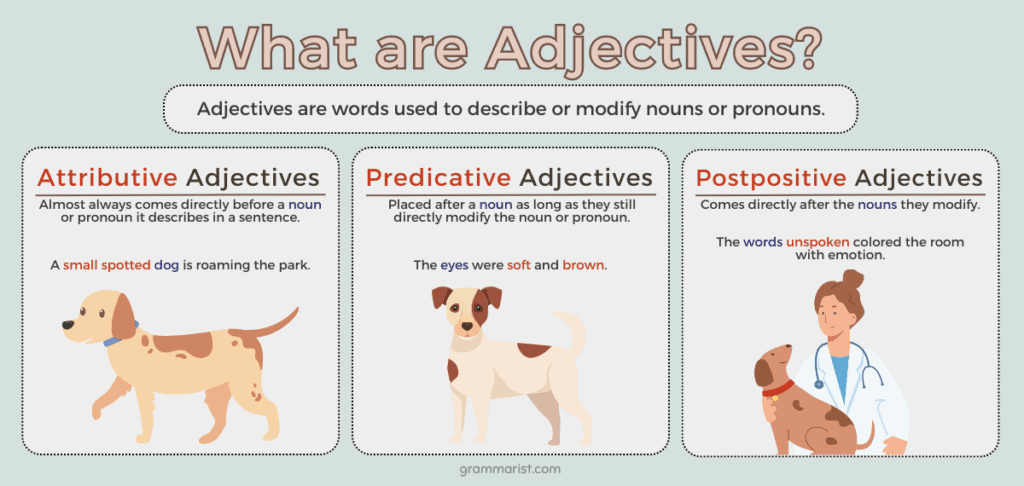
Adjectives are words used to describe or modify nouns or pronouns. For example, words like red, quick, happy, and obnoxious are adjectives since they can describe things such as a red hat, the quick rabbit, a happy duck, or an obnoxious person.
Adjectives are partially defined by their placement in a sentence to create a modification.
Attributive Adjectives
An attributive adjective almost always comes directly before a noun or pronoun it describes in a sentence. Sometimes there is more than one adjective as well.
For example:
- The small spotted dog was the last left of his litter, but the old man couldn’t turn away from the soft brown eyes and brought him home.
Predicative Adjectives
Predicative adjectives are placed after a noun as long as they still directly modify the noun or pronoun. However, when an adjective comes after a noun, it does not immediately follow the noun; instead, it follows a verb.
For example:
- The dog was small, spotted, and the last of his litter.
- The eyes were soft and brown.
Postpositive Adjectives
Adjectives that come directly after the nouns they modify are called postpositive adjectives. These are rare in English, but there are a few adjectives that are always postpositive (such as galore and extraordinaire). Adjectives are sometimes postpositive when the writer wants to sound poetic.
For example:
- The words unspoken colored the room with emotion.
- It seemed that the songs half-heard were whispering in the wind.
- The best part of the vacation was the desserts galore every restaurant offered.
Understanding the Basics of Adjectives
To recognize an adjective, you need to understand that many different words can function as adjectives when appropriately placed in a sentence. This is why attempting to create an exhaustive list of all the adjectives in existence would be massive and confusing without context.
Adjectives are categorized in a way that helps you understand their original part of speech and how they can be used to modify nouns and pronouns, adding a descriptive element.
What Is an Example of an Adjective?
Examples of adjectives include words that describe:
- Location (Germanic language).
- Color (fuschia gown).
- Shape or size (large, square structure).
- Age (eldest son).
- Material (dirty washcloth).
- Purpose (hilarious play).
How Is an Adjective Different From a Noun, Verb and Adverb?
An adjective can be a noun or verb, but it cannot be an adverb.
Nouns describe a person, place or thing, while verbs describe an action. Each can be placed before a noun or pronoun to modify its meaning and use.
For example:
- She grew up in a stone house that stayed cool in the summer and warm in the winter.
In this sentence, stone is a noun acting as an adjective to describe the type of house our subject grew up in.
- The running course passed through the field and over the bridge before ending at the park.
In this sentence, running is a verb used as an adjective to modify the noun “course.” Many verbs that end in -ing or -ed can function as an adjective when modifying a noun.
We know that adjectives describe nouns and pronouns, while adverbs describe verbs. For example, “lavish lifestyle” is an adjective phrase where “lavish” is the adjective and “lifestyle” is the noun it modifies. “Living lavishly” is an adverbial phrase where “living” is a verb and “lavishly” is an adverb.
How to Pronounce “Adjective” Correctly
Adjective is pronounced a-juhk-tuhv and silences the d.
Different Types of Adjectives and Examples
Adjectives are an important part of speech that add interest to the nouns and pronouns in your sentences. The different types of adjectives modify a noun or pronoun to provide much more information to your sentences and can answer questions such as “Which one?” “What kind?” and “Whose is it?”
Nouns as Adjectives
Most nouns can easily become an adjective when placed in front of another noun to modify it. A noun used as an adjective answers the following questions about the noun following it:
- What kind?
- Which one?
For example:
- What kind of juice are you buying at the store? I am buying apple juice.
- Which camp are you attending this summer? I am going to a sea turtle summer camp.
Proper Adjectives
Proper adjectives are proper nouns used to modify another noun. Because they are nouns, they modify by answering the question “What kind?” or “Which one?” and are always capitalized.
For example:
- What kind of cheese did you bring home from your trip to the dairy? We brought home a selection of Vermont white cheddar and Wisconsin curds.
- Which play did you end up bringing your son to? He preferred the Shakespearean plays over the other selections, and we saw three different productions that weekend.
Verbs as Adjectives
Some verb forms, especially those that end in –ing and -ed, are used as adjectives to modify a noun.
For example:
- The singing bird perched on the branch mesmerized the audience.
- The melted ice cream cone looked so sad and forlorn in the middle of the sidewalk; some children must have been disappointed when they dropped it.
Pronouns as Adjectives
Certain pronouns can be used as adjectives as well. Some pronouns serve as both an adjective and a pronoun in the same sentence when it modifies a noun.

For example:
- Her colorful dress caught everyone’s attention at the party.
- Their old house has a beautiful garden in the backyard.
Possessive Adjectives
There are seven personal pronouns known as possessive pronouns or possessive adjectives. They are considered a pronoun because they have an antecedent. An antecedent is a person, place, thing, or clause represented by a pronoun. It also is an event or cause that chronologically comes before something else.
Possessive adjectives are also adjectives because they modify nouns and answer the question, “Which one?”.
The seven personal pronouns are:
- My
- Your
- His
- He
- Its
- Our
- Their
For example:
- The flock flew to its summer breeding grounds.
In this sentence, flock is the antecedent, it is the possessive adjective, and grounds is the modified noun.
Demonstrative Adjectives
All four demonstrative pronouns can also be used as adjectives when they are placed directly before the nouns they are modifying and are never found directly before a verb.
The four demonstrative adjectives are:
- This
- That
- These
- Those
For example:
- Did you drop this book?
In this sentence, the pronoun this becomes a demonstrative adjective when placed directly before the modified noun book.
Interrogative Adjectives
Specific interrogative pronouns become an interrogative or questioning adjective when placed directly before the noun they are modifying.
The three interrogative adjectives are:
- Which
- What
- Whose
For example:
- What color are her eyes?
In this sentence, the interrogative pronoun what becomes an interrogative adjective because it modifies the noun color and answers the question, “What kind?”.
Indefinite Adjectives
There are many indefinite pronouns that become indefinite adjectives when they modify singular or plural nouns. Therefore, the indefinite adjective is either singular, plural, or can act as both.
Indefinite adjectives include:
Singular
Another
Each
Either
Little
Much
Neither
One
Plural
Both
Few
Many
Several
Singular or Plural
All
Any
More
Most
Other
Some
For example:
- The squirrel stole only one nut.
- Many mammals call the Arctic home.
- We saw some dolphins on our tour.
Compound Adjectives
Compound adjectives are adjectives made up of more than one word. Many compound adjectives are either hyphenated or combined as one word.
For example:
- After visiting Kennedy Space Center, my children became obsessed with freeze-dried fruit.
- Many of our janitors at the school are considered underpaid staff, and a movement was in place to allocate better pay.
Distributive Adjectives
Distributive adjectives refer to objects in a group individually. Popular distributive adjectives include the words each, every, either, neither, any, and both.
For example:
- Every dog in the shelter receives a daily walk and weekly bath.
- Both children will have the chance to compete in the spelling bee.
Limiting Adjectives
Unlike descriptive adjectives, which provide details of the quality or trait of something, limiting adjectives restrict the qualities or traits of a noun or pronoun. For example, instead of saying, “Micah has beautiful flower beds,” you can say, “Micah has many flower beds.”
There are different types of limiting adjectives which include:
Demonstrative Adjectives
Demonstrative adjectives indicate a relative physical location or moments in time. They include this, that, these, and those.
Interrogative Adjectives
Interrogative adjectives are limiting because they ask a question about a specific noun without describing it. They include whose, what, and which.
Quantitative Adjectives
Quantifying adjectives are limiting because they group nouns together or indicate the amount of something. These adjectives do not provide qualities of the nouns they modify.
Quantitative adjectives include words such as many, some, couple, all, and several. Cardinal numbers, such as one, thirty, and one thousand, are also quantifying adjectives, as are ordinal numbers, such as second, tenth, or thirtieth.
Possessive Adjectives
Possessive adjectives provide information about possession but limit the noun due to a lack of description. These include my, your, his, her, its, our, their, and whose.
Articles
Determiners limit adjectival words and precede the noun or pronoun without describing them. These include a, an, and the.
Other Types of Adjectives
As you can see from the examples above, an adjective can have more than one label. The following types of adjectives aren’t as well recognized but are well used in speech and writing.
Participial Adjectives
Participles are words derived from a verb that ends in -ed or -ing, used to construct adjectives or verb tenses. It is important to recognize that there are irregular participles, such as grown, broken, or hidden.
Participial adjectives are formed by taking a participle and using it as an adjective.
For example:
- The children stumbled upon the hidden room.
- She enjoyed the sound of the chiming clock.
Denominal Adjectives
Denominal adjectives are formed by nouns that have an addition of a suffix. Suffixes include:
- -y
- -al
- -ful
- -ous
- -less
- -ly
- -ic
- -ish
- -esque
- -en
For example:
- They searched for the treasure behind the earthen mounds.
- He was such a cowardly man to avoid his family in such a manner.
- The heroic storyline was well-received by audiences worldwide.
Appositive Adjectives
Appositive adjectives are adjectives or a series of adjectives that follow a noun and are set off by dashes or commas.
For example:
- Many of the films, modern and artistic, have included an empowerment of the female form.
- The many critiques of her life encompassed the same sentiments concerning her reputation—brilliant, colorful, and controversial.
How Many Degrees of Comparison Do Adjectives Have?
All adjectives used to compare more than one object have three degrees of intensity: positive, comparative, and superlative. These forms help explain the importance of two or more objects in comparison to one another.
Positive Adjectives
Positive forms of comparison denote objects that have equal degrees of quality. The word “as” is used both before and after the adjectives to highlight this.
For example:
- Her last song was as popular as the previous one.
It can also be used in the negative to mean that two objects are not similar.
For example:
- This test was not as easy as the last one.
Comparative Adjectives
The comparative form is used to denote objects that have a stronger or weaker degree of quality.
For example:
- He is smarter than his sister but not as popular.
- Her interior design was more detailed than the rest of the class.
Superlative Adjectives
The superlative form is used to denote objects that have the strongest or weakest degree of quality.
For example:
- My new puppy is the smartest of his entire litter.
- The drink was the most disgusting thing I’ve ever tasted.
How to Form Degrees of Comparison
To form a degree of comparison from an adjective, remember the following rules:
One Syllable Adjectives
Comparative
add -er:
higher
Superlative
add -est:
highest
Two-Syllable Adjectives
Comparative
add -er or precede with more:
sunnier, more sunny
Superlative
add -est or precede with most:
sunniest, most sunny
Three or More Syllable Adjectives
Comparative
precede with more:
more fanciful
Superlative
precede with most:
most fanciful
Quick Reference Chart
smart
Positive:
smarter
Comparative:
smarter
Superlative:
smartest
tricky
Positive:
tricky
Comparative:
trickier, more tricky
Superlative:
trickiest, most tricky
beautiful
Positive:
beautiful
Comparative:
more beautiful
Superlative:
most beautiful
hard
Positive:
hard
Comparative:
harder
Superlative:
hardest
funny
Positive:
funny
Comparative:
funnier, more funny
Superlative:
funniest, most funny
How to Order Adjectives: Cumulative Adjective Examples
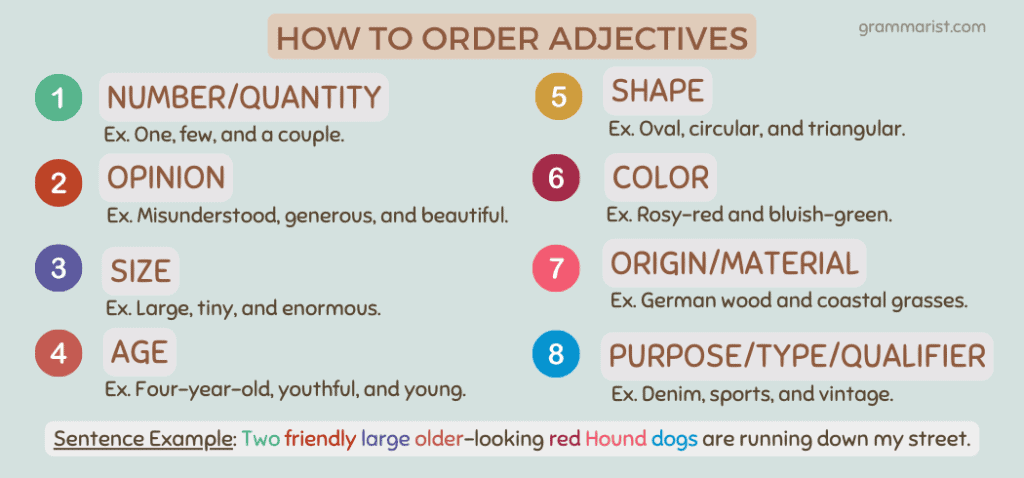
Cumulative adjectives modify a noun by building meaning. Cumulative adjectives are two or more adjectives listed before a noun that must be placed in a specific order to convey the meaning of the sentence.
Most people order adjectives according to what sounds “right” rather than “wrong” and follow a set pattern of speech. This pattern has become widely accepted as the correct way to list adjectives when modifying nouns and pronouns for detail and clarity.
Another way to explain this is the closer an adjective is to the noun, the more important it is to the noun’s description.
It is common to use more than one adjective when describing a noun, and their order should be consistently used from one sentence to another.
The accepted order of adjectives (with slight variations to accommodate word flow) is as follows:
Number/Quantity
The amount of your noun goes first. For example, one, few, many, six, a couple, etc.
Opinion
An opinion about the noun helps an audience determine what the author feels about the noun. For example, words such as misunderstood, valuable, downtrodden, generous, beautiful, etc., help describe a noun.
Size
The size of the noun belongs towards the beginning of your description. For example, adjectives such as large, small, tiny, minute, enormous, etc., provide the reader with an idea of how much space is taken up.
Age
Age can be described as a year, such as four-year-old, or can be descriptive, such as old, youthful, elderly, young, etc.
Shape
Use shapes such as oval, circular, rectangular, triangular, etc.
Color
Descriptive colors belong closer to the nouns. Feel free to use compound color options as well, such as rosy-red, bluish-green, pasty-white, etc.
Origin/Material
Depending on who you ask, the origins of a noun could also mean the materials of the noun. If you happen to use both a physical location for the origin and a material, place the origin first. For example, German wood, coastal grasses, Western lumber, European spring water, mountain air, etc.
Purpose/Type/Qualifier
This is another category that can be interpreted differently. The purpose of your noun, such as whether it is sleep, driving, running, etc., trumps the type (or qualifying detail). Qualifying details include things like Hound, denim, sports, vintage, etc.
For example:
- Six beautiful small antique round red Japanese teacups were displayed on the shelf.
- Three large oval white American serving platters adorned the dining table.
Number /Quantity
seven
Opinion
lovely
Size
tiny
Age
old
Shape
square
Color
green
Origin/Material
Italian, cotton
Purpose/Type/Qualifier
sleeping, modern
When to Use Commas Between Adjectives
Punctuating a list of two or more adjectives in a sentence is actually very easy. Some require a comma, and some do not. These two simple rules will help you keep your sentences properly punctuated:
Comma Rule #1:
When two or more adjectives come from the same category, they need to be separated by commas.
For example:
- I took my versatile, comfortable, dependable car on a road trip.
Comma Rule #2
When two or more adjectives come from different categories, no commas are needed.
For example:
- The three bossy large white geese reign over the barnyard.
Also, never place a comma between the final adjective and the noun.
Adjective Worksheet
Quickly test your understanding of adjectives with this worksheet that reviews the various ways an adjective can be used.
How to Teach Adjectives to Grade-Level Students Using Worksheets
Worksheets are excellent ways to help teach adjectives to elementary students. Be sure to provide the definitions of the adjectives you want your students to recognize and offer various examples for them to work from during your lessons. Use worksheets as a form of assessment to test their understanding.
Final Thoughts on Adjective Words
Adjectives are words used to describe or modify nouns or pronouns and can be found either directly before or after a noun or following the verb that comes after the noun it modifies.
Adjectives are made up of nouns, verbs, and pronouns and are different from adverbs in that they only describe nouns and pronouns, while adverbs describe verbs or fellow adverbs.
Adjectives are an important part of speech that add detail and description to a sentence. Different types of adjectives provide answers to questions such as “Which one?” “What kind?” and “Whose is it?”
How Can Mastering Adjectives Improve Your English Skills and Understanding of Grammar?
Without adjectives, sentences are simple and unadorned and often lack important detail needed for an understanding of the message. When you use adjectives, you are providing your audience with a deeper understanding of the many different aspects your message entails. Physical characteristics, emotional responses, and even specific directions can be better understood through the use of adjectives.
When you understand how an adjective works, you can also better understand what others are trying to tell you. They are crucial for improving your overall speech and writing comprehension skills.
FAQs
Take a look at the answers to these frequently asked questions concerning adjectives.
What Are 5 Adjectives That Can Be Used in Everyday Conversation?
There are countless numbers of words that can be used as an adjective to modify a noun or pronoun, but almost all will fall into one of the following categories:
- Noun adjectives
- Pronoun Adjectives
- Verb Adjectives
- Proper Adjectives
- Compound Adjectives
What’s the Difference Between an Adjective and an Adverb?
As explained above with examples, adjectives describe nouns and pronouns, while adverbs describe verbs or fellow adverbs.
What Is the Role of Adjectives in a Chart or Graph?
Because adjectives are descriptive, you can easily use them to help detail what sort of data is being used within a chart or graph. For example, you could say the straight red lines represent the negative results, while the curved blue line provides growth information.
How Can Adjectives Be Used to Create a Positive or Negative Tone?
The descriptive nature of adjectives allows you to create almost endless possibilities of detail—including the use of negative or positive connotations through word choice. For example, the room can become a dark, sinister room, or the room can become a light, airy room.