


An adverb is a word that provides information about other words in a sentence. It works to clarify and add details about how, what, where, or when something occurs. Adverbs are key in English because they make it easier for people to understand what you’re saying.
Adverbs are different from adjectives. While adjectives describe nouns and pronouns—answering questions like “what kind?” or “how many?”—adverbs focus on describing verbs, other adjectives, or even other adverbs.
Let’s learn more about what adverbs are and how you can use them to create a more detailed and understandable sentence.
What Is An Adverb?
Adverbs are words that give more details about other words in a sentence. They can describe a verb, an adjective, or even another adverb.
The word adverb is from the late 14th century and comes from the Latin word “adverbium,” which literally means “something added to a verb.” It serves the same purpose today as it did back then—to enhance or clarify the action in a sentence. Its overall use is even older than its Latin roots; it was translated from the Greek word “epirrhema,” which also means “on or upon a verb.”
So what does an adverb do? It answers one of four questions about the word it’s modifying:
- Where?
- When?
- In what way?
- To what extent?
Understanding adverbs can help make your sentences more informative and easier to understand.
Types of Adverbs

Adverbs are versatile words that add more detail to verbs, adjectives, or even other adverbs. But not all adverbs are created equal. Different types of adverbs add various kinds of information to make actions and descriptions in a sentence clearer.
Let’s explore how adverbs work within sentences to give readers a better understanding of what you’re trying to say.
Adverbs of Manner
Adverbs of manner tell us how an action is performed or how something happens. They usually come right after the main verb.
Examples:
- Margot exclaimed loudly, “This is so beautiful!”
- Harry watched closely.
If the verb has a direct object, place the adverb before the verb or at the end of the sentence instead. Never place the adverb between the verb and the direct object.
Examples:
- Margot loudly exclaimed how beautiful the sunset was.
- Harry watched the game closely.
Adverbs of Frequency
Adverbs of frequency tell us how often something happens, and they come in two categories: indefinite and definite.
Adverbs of Indefinite Frequency
These adverbs provide us with a general idea of how often something happens but don’t give an exact timeframe. Place these adverbs before the main verb in a sentence.
Examples:
- Michael never turns in his homework on time.
- Anna sometimes tutors her classmates.
Adverbs of Definite Frequency
These adverbs, on the other hand, tell us exactly how often something happens by giving us a specific description of time. They usually go at the end of a sentence.
Examples:
- We travel to South Carolina yearly.
- I help deliver meals weekly.
Adverbs of Time and Duration
Adverbs of time and duration give us more information about when an action takes place and how long it lasts.
Adverbs of Time
These adverbs tell us when a specific action occurs and are generally placed at the end of a sentence.
Example:
- My son has a project due today; he spent hours working on it yesterday.
Adverbs of Duration
These adverbs indicate how long an action lasts. Like adverbs of time, they’re usually found at the end of a sentence or clause.
Examples:
- The alarm system should reset shortly.
- He worked at the theater temporarily; the job was good for extra seasonal cash.
Adverbs of Place
Adverbs of place provide information about where an action takes place. Its placement usually follows the main verb of a sentence.
Examples:
- The papers were scattered everywhere across the floor.
- Go outside and watch for the package delivery.
Adverbs of Degree
Adverbs of degree help us understand how much or to what extent something is the case.
Examples:
- She was extremely upset.
- They were slightly late to the party.
- He should be ready soon.
Adverbs of Probability
An adverb of probability helps define how certain or likely something is to happen. Depending on the specific adverb, it can be placed at the beginning of a sentence or right before the main verb.
Examples:
- I definitely will be at the party.
- Perhaps my brother will show up.
- It will probably rain if the forecast is correct.
Conjugative/Linking Adverbs
A conjugative or linking adverb connects two independent clauses to one another. This is done by changing the second clause into an adverbial modifier. A linking adverb differs from a coordinating conjunction because it specifically introduces a relationship like comparison, contrast, condition, or clarification between the clauses.
Example:
- Jose didn’t make it to the final tuition scholarship interviews; consequently, he was able to apply for another option that provides living expenses.
Adverbs of Purpose or Reason
An adverb of purpose (or adverb of reason) offers an explanation of why something is the way it is. Some adverbs of purpose function as linking adverbs, connecting two ideas, while others form adverbial phrases that modify verbs.
Examples:
- His children didn’t finish their chores; therefore, they couldn’t go to their friends’ houses over the weekend.
- Because you failed to record your hours, your paycheck will be late.
Focusing Adverbs
Focusing adverbs emphasize a particular word or part of a sentence, highlighting its importance or specificity. These are placed right next to the word they aim to emphasize.
Examples:
- Wyatt enjoys golfing, especially on the weekends.
- Michael was tardy, but only once.
Interrogative Adverbs
Interrogative adverbs are used specifically to introduce questions. The most common ones include when, why, how, and where.
Examples:
- Where did you buy those pants?
- She asked what you were doing.
Evaluative Adverbs
Evaluative adverbs are used to express the tone or voice of the author about the information in the clause that follows the action. These adverbs usually come before the clause they’re modifying and are often set off by a comma for clarity.
Examples:
- Hopefully, she will show up on time.
- The bus arrived late, but fortunately, being tardy all the time finally paid off.
Relative Adverbs
Relative adverbs introduce dependent or relative clauses. Unlike independent clauses, these clauses have a subject but don’t form a complete thought on their own. The common relative adverbs are where, when, and why.
Examples:
- This is the beach where he proposed to me.
- That was the trip when she fell overboard.
Position of Adverbs in Sentences/Placement of Adverbs
As we’ve discussed, the position of an adverb in a sentence can vary depending on its type and the word it modifies. Here’s a handy guide to help you figure out where to place different kinds of adverbs:
Adverbs of Manner
Mid position:
She quickly ate her dinner.
End position:
She ate her dinner quickly.
Adverbs of Frequency
Beginning:
Sometimes the dog wakes me up.
Mid position:
I usually wake up on my own.
End position:
The dog doesn’t jump on the bed often.
Adverbs of Time/Duration
Beginning:
Today, I’m going out to lunch.
End position:
I’m going out to lunch tomorrow.
Adverbs of Place
Beginning:
Outside, there was a large forest.
End position:
Would you like dinner served here?
Adverbs of Degree
Mid Position:
I really improved my writing last year.
End position:
We travel cross-country a lot.
Adverbs of Probability
Beginning:
Maybe I’ll wake up early tomorrow.
Mid Position:
I’ll probably wake up early tomorrow.
End position:
Can I offer you refreshment, perhaps?
Conjugative/Linking Adverbs
Mid Position:
The students stayed after school because they were late to class.
Adverbs of Purpose/ Reason
Beginning:
Personally, I’m not a fan of her work.
Mid Position:
She was, honestly, the worst person I had ever met.
Focusing Adverbs
Mid Position:
She finally showed up to class on time.
Interrogative Adverbs
Beginning:
What did you tell her?
Mid Position:
She asked when you finished the test.
Evaluative Adverbs
Beginning:
Unfortunately, I failed my driving test and had to take it over.
Mid Position:
I had stupidly forgotten to let the dogs out before we left.
End position:
She missed the point, apparently.
Relative Adverbs
Mid Position:
This is the cliff where I survived a fall from two stories up.
How to Form Adverbs
Knowing what purpose adverbs serve and where they fit into a sentence is just the first part of understanding their use. You also need to know how to form them from other parts of speech so they make sense in the context and tense in which they are being used.
Forming Adverbs From Adjectives
Adverbs are usually formed from adjectives by adding the suffix “-ly.” However, there are some exceptions. Take a look at how to change an adjective into an adverb and what to do when the suffix “-ly” doesn’t work.
Regular Adjectives
For most regular adjectives, you can simply add “-ly” to the end.
- Adjective: quick
- Adverb: quickly
Adjectives ending in -y
If the adjective ends in “-y,” change the “-y” to “-i” and add “-ly.”
- Adjective: happy
- Adverb: happily
Adjectives ending in -le
For adjectives ending in “-le,” replace the “-le” with “-ly.”
- Adjective: simple
- Adverb: simply
Irregular Adjectives
Some adjectives don’t follow a set pattern when they become adverbs. You’ll just have to memorize these.
- Adjective: good
- Adverb: well
- Adjective: fast
- Adverb: fast
Exceptions
Not all adverbs are formed by adding “-ly.” Some keep the same form as the adjective.
- Adjective: hard
- Adverb: hard
Forming Adverbs From Irregular Word Forms or Without Changing Form
While many adverbs are created by adding “-ly” to an adjective, there are also adverbs that don’t change form at all. Here’s what you need to know about these unique cases:
Using the Same Form
In some instances, adjectives and adverbs share the same form. These adverbs are considered irregular. They are typically related to adjectives that end in “-ly” or have the same spelling as their adjectival forms.
Examples:
Adjective: lively
- She enjoyed a lively evening at the dance
Adverb: lively
- She responded lively.
Adjective: fast
- He drives a fast car.
Adverb: fast
- He drives fast.
Forming Adverbs Using Prepositional Phrases
Adverbs can be formed using prepositional phrases, which provide added details about the manner, place, time, frequency, or other aspects related to an action. A prepositional phrase consists of a preposition (a word that shows the relationship between a noun or pronoun and other words in a sentence) and its object (usually a noun or pronoun).
An adverbial prepositional phrase is a group of words that functions as an adverb in a sentence to form a phrase that modifies a verb, adjective, or adverb.
Here’s how to use prepositional phrases as adverbs in different contexts:
Manner
These phrases describe how an action is performed.
- She sings with enthusiasm.
Place
These tell us where an action takes place.
- They met at the park.
Time
These phrases indicate when an action occurs.
- We’ll meet after dinner.
Frequency
These phrases describe how often an action happens.
- He exercises twice a week.
Cause or Reason
These show why an action is taking place.
- Due to the heavy traffic, we arrived late.
Condition
Use these phrases to express under what circumstances an action happens.
- We will have the picnic on the condition that the weather is nice.
Comparison
These phrases are useful for comparing two actions or situations.
- She types faster than her coworkers.
Purpose
Such phrases indicate why an action is being done.
- He studies to improve his grades.
Matter of Degree
These phrases show to what extent or degree an action is being performed.
- The water is too cold for swimming.
Contrast
Use these phrases to highlight a difference or contradiction between two actions or situations.
- She’s friendly with everyone except him.
Forming Compound Adverbs
Compound adverbs are multi-word adverbs that offer more specific meanings. These can be formed in various ways to provide a richer, more nuanced description of actions, qualities, or conditions.
Combining Two or More Adverbs
You can combine two or more adverbs to create a compound adverb that provides a more detailed description of an action.
Example:
Adverbs: slowly, cautiously
- She walked slowly and cautiously.
Adding Intensifiers or Modifiers
You can add intensifiers or modifiers to a compound adverb to change its emphasis or meaning. Common intensifiers include very, extremely, and quite. Modifiers can specify the degree or manner of the action.
Example:
Adverb: carefully
- He drove very carefully.
Using Comparative and Superlative Forms
Some compound adverbs can be modified with comparative and superlative forms to indicate degrees of comparison.
Example:
Adverb: quicky
- She finished the race more quickly than her teammate.
Using Synonyms
You can replace one of the adverbs in a compound adverb with a synonym to create a variation of the original compound adverb.
Example:
Adverbs: eagerly and excitedly
- They awaited the announcement eagerly and enthusiastically.
Rearranging Word Order
Altering the word order in a compound adverb phrase can shift its emphasis or meaning.
Example:
Adverb phrase: quietly in the corner
- She sat in the corner quietly.
Adding Prefixes or Suffixes
Occasionally, you might add prefixes or suffixes to a compound adverb to modify its meaning or form.
Example:
Compound Adverb: early morning
- They arrived earlier in the morning.
Forming Negative Adverbs
Forming negative adverbs involves adding prefixes to existing adverbs. This changes their meaning to indicate the opposite action or quality or to negate it altogether.
Here’s how you can form negative adverbs:
Adding “Un-” or “Dis-“
Use prefixes like “un-” or “dis-” to flip the original meaning of an adverb.
- Adverb: happily, advantageously
- Negative Adverb: unhappily, disadvantageously
Adding “Non-“
The prefix “non-” also works to create negative adverbs that suggest the absence or lack of the quality described by the original adverb.
- Adverb: existent, violently
- Negative Adverb: nonexistent, nonviolently
Adding “In-” or “Im-” (or their variations)
These prefixes can be added to certain adverbs to create negative forms by negating the action or quality.
- Adverb: completely, morally
- Negative Adverb: incompletely, immorally
Using “Un-,” “In-, or “Ill-” with Hyphenated Adverbs
In some cases, when the original adverb is hyphenated, the negative form is also hyphenated.
- Adverb: well-dressed
- Negative Adverb: ill-dressed
Adding “A-” or “An-“
The prefixes “a-” and “an-” can be added to adjectives that sometimes function as adverbs to create negative forms.
- Adverb: symmetrically
- Negative Adverb: asymmetrically
Using “Never” and “Nowhere”
Instead of using prefixes, you can also use negative adverbs like “never” and “nowhere” to negate actions or indicate absence.
- Adverb: there
- Negative Adverb: never there
Forming Adverbs From Nouns
While adverbs are often single words derived from adjectives, you can also use nouns to create adverbial phrases. These phrases usually describe the manner or context in which an action occurs. Here’s how to do it:
Using Noun + “ly”
In some cases, you can add the suffix “-ly” to a noun to form an adverb.
- Noun: year
- Adverb: yearly (indicating the frequency with which something is done each year)
For example:
- She checks her soil chemistry levels yearly to ensure her plants will grow well.
Using Noun + Numerical Modifier
A noun combined with a numerical modifier can create an adverbial phrase that specifies the extent or measure of an action.
- Noun: miles
- Adverbial phrase: three miles (indicating the distance traveled)
For example:
- It felt as if they had walked more than three miles.
Using Noun + Preposition
By adding a preposition to a noun, you can form an adverbial phrase that specifies the timing or context of an action.
- Noun: December
- Adverbial phrase: before December (indicating that something is done before a specific time of year)
For example:
- Make sure you wrap presents before December!
Using Noun + Verb Phrase
Sometimes, a noun can be part of an adverbial phrase combined with a verb to describe the manner or timing in which an action is performed.
- Noun: moment
- Adverbial phrase: waited a moment
For example:
- Her question would have been answered if she had only waited a moment.
Using Noun + Infinitive
A noun and the infinitive form of a verb can form an adverbial phrase that describes the manner or purpose of an action.
- Noun: bed
- Adverbial phrase: to bed to sleep
For example:
- Monica went to bed to sleep.
Using Adverbs Correctly
The appropriate use of adverbs involves more than just knowing how to form them and where to place them in sentences. It’s also crucial to understand how adverbs interact with different parts of speech to convey the intended meaning clearly and effectively.
Using Adverbs with Verbs
Using adverbs with verbs is the most common way to provide more information about how an action is performed. We have gone over this in detail above, but it doesn’t hurt to see how adverbs work specifically with verbs compared to other parts of speech.
Adverbs modify verbs by adding details such as manner, frequency, time, place, degree, and more. Using adverbs with verbs can enhance your communication by providing additional context and detail.
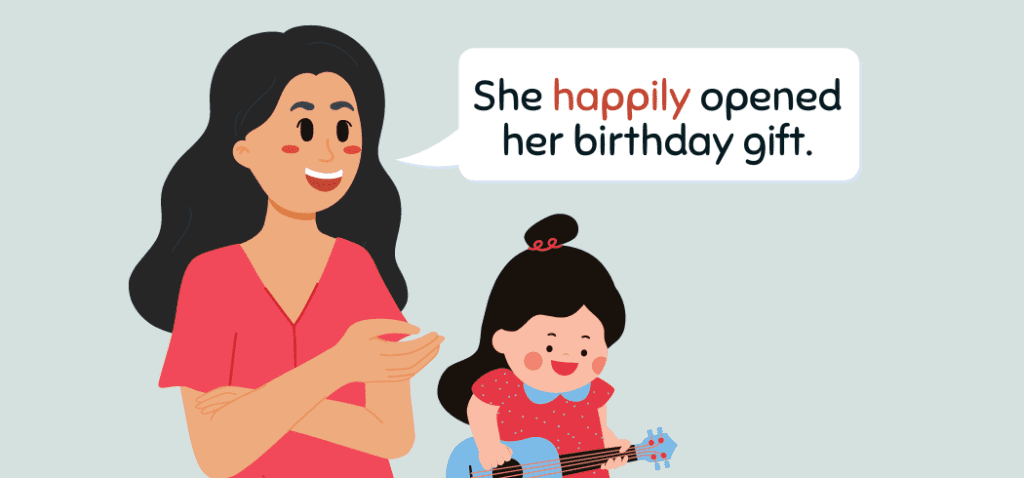
Here are some examples of using adverbs with verbs:
Manner Adverbs
Manner adverbs describe how an action is carried out.
- He runs quickly.
Frequency Adverbs
Frequency adverbs indicate how often an action occurs.
- They go to the gym regularly.
- He doesn’t eat sweets very often.
Time Adverbs
Time adverbs provide information about when an action takes place.
- She arrived yesterday.
Place Adverbs
Place adverbs describe where an action occurs.
- The cat likes to sleep here.
Degree Adverbs
Degree adverbs modify the intensity or degree of an action.
- He speaks English fluently.
Affirmation and Negation Adverbs
These adverbs indicate whether an action is confirmed or denied.
- He certainly understands.
- He hardly knows.
Comparative and Superlative Adverbs
Comparative adverbs compare the intensity of actions, while superlative adverbs indicate the highest degree.
- She drives more carefully than he does.
- He works the hardest in the office.
Conjunctive Adverbs
These adverbs connect ideas, showing relationships between clauses or sentences.
- We can go for a walk; meanwhile, you can prepare dinner.
Interrogative Adverbs
Interrogative adverbs introduce questions about the manner, place, time, or reason for an action.
- Why did she leave so early?
To use adverbs effectively with verbs, make sure you:
- Avoid redundancy: If the verb already conveys the adverb’s meaning, there’s no need for the adverb.
- Example: “Whisper quietly” is redundant since whispering is inherently a quiet action.
- Choose the adverb that adds the most meaning: Opt for an adverb that gives new information or adds nuance to the verb.
- Example: Saying “The fire spread rapidly” is more informative than “The fire spread fast.”
- Placement: Place the adverb close to the verb it modifies to prevent confusion.
- Example: “She almost drove her kids to school” vs. “She drove her kids to school almost.”
Using Adverbs With Adjectives
Using adverbs with adjectives is a way to provide more information about the degree or intensity of a quality described by the adjective. Adverbs can help you be more precise and descriptive in your writing.
Intensifying Adverbs
Intensifying adverbs enhance the meaning of an adjective by emphasizing the degree or extent of the quality.
- The extremely delicious cake was served.
Degree Adverbs
Degree adverbs modify adjectives to indicate the level or extent of a quality.
- The movie was fairly entertaining.
Using Adverbs With Other Adverbs
Using adverbs with other adverbs can provide additional information about how an action is performed, the degree of an action, or the relationship between multiple actions. These typically form compound adjectives, as described above.
Modifying Adverbs
These adverbs can modify other adverbs to give more detail about the manner in which an action is performed.
- He ran very quickly to catch the bus.
Comparative and Superlative Adverbs
Just like adjectives, some adverbs can be used in comparative and superlative forms to show differences in degree or quality between actions.
- She answered the question most confidently of all.
- He runs faster than she does.
Adverbs of Frequency with Adverbs
These adverbs indicate how often an action takes place. When paired with another adverb, they give us more detail about the frequency of an action.
- He exercises quite frequently to stay in shape.
Adverbs of Degree with Adverbs
These adverbs are used to emphasize just how much or to what extent another adverb applies.
- She was extremely pleased with the results.
Comparative and Superlative Adverbs
Comparative and superlative adverbs help us express differences in intensity, quality, or degree when we’re talking about actions, qualities, or conditions. They work similarly to comparative and superlative adjectives, but they modify verbs, adjectives, or other adverbs instead of nouns or pronouns.
Forming Comparatives
To create a comparative adverb, you have two main options:
- Add “-er” to the end of the adverb (usually only applicable for single-syllable adverbs).
- Use the word “more” before the adverb.
Examples:
- He ran more quickly than his classmates and won the race.
- He ran faster than his classmates and won the race.
Forming Superlatives
For superlative adverbs, the rules are similar. You can:
- Add “- est” to the end of the adverb (again, generally for single-syllable adverbs).
- Use the word “most” before the adverb.
Examples:
- He ran the most quickly in his class.
- He ran the fastest in his class.
Tips and Considerations for Using Comparative and Superlative Adverbs
To help you better use comparative and superlative adverbs, take a look at the following examples to help you see how to form each from commonly used adverbs.
Adverb: quick
- Comparative: quicker, more quickly
- Superlative: quickest, most quickly
Adverb: loud
- Comparative: louder, more loudly
- Superlative: loudest, most loudly
Adverb: careful
- Comparative: carefuller, more carefully
- Superlative: carefullest, most carefully
Adverb: easy
- Comparative: easier, more easily
- Superlative: easiest, most easily
Adverb: soft
- Comparative: softer, more softly
- Superlative: softest, most softly
Remember that some adverbs have irregular forms for the comparative and superlative degrees, similar to adjectives.
Adverb: well
- Comparative: better
- Superlative: best
Adverb: badly
- Comparative: worse
- Superlative: worst
Adverb: far
- Comparative: farther
- Superlative: farthest
Common Adverb Errors
Adverbs can be a bit tricky, but they’re key to speaking and writing English well. Here are some common mistakes people make with adverbs, along with tips on how to avoid them:
- Misplacing Adverbs
Make sure to put adverbs close to the word they’re modifying to avoid confusing your reader.
- Incorrect: She almost drove every day.
- Correct: She drove almost every day.
- Double Negatives
Avoid using two negatives in a sentence as it can make your message unclear.
- Incorrect: He can’t get no work done hardly.
- Correct: He can hardly get any work done.
- Confusing Adjectives for Adverbs
Adjectives modify nouns, while adverbs modify verbs, adjectives, or other adverbs. Using an adjective instead of an adverb (or vice versa) can lead to incorrect sentences.
- Incorrect: She sings beautiful.
- Correct: She sings beautifully.
- Using Good and Well Incorrectly
“Good” is an adjective, and “well” is an adverb. Use “good” to describe nouns and “well” to describe verbs, adjectives, and other adverbs.
- Incorrect: She plays the piano good.
- Correct: She plays the piano well.
- Overusing Very
While “very” can add emphasis, using it too frequently can make writing repetitive. Consider using stronger adjectives or adverbs instead.
- Incorrect: The movie was very, very exciting.
- Correct: The movie was extremely exciting.
- Using Literally Inaccurately
“Literally” should only be used to describe something that actually happened, not as a way to emphasize a point.
- Incorrect: I was so tired, I literally flew home.
- Correct: I was so tired, I practically dragged myself home.
- Correct: I was literally dragging my feet on the way home.
- Incorrect Adverb Forms
Some adverbs have irregular forms. Be sure to use the correct form of the adverb.
- Incorrect: He runs more well than his friend.
- Correct: He runs better than his friend.
- Using Too and Very Interchangeably
“Too” implies excess or going beyond a limit, while “very” simply intensifies a quality.
- Incorrect: The coffee is very hot to drink.
- Correct: The coffee is too hot to drink.
- Incorrectly Using Hard and Hardly
“Hard” is usually an adjective or adverb that describes the level of effort, while “hardly” means barely or almost not at all.
- Incorrect: I worked hardly on the project.
- Correct: I worked hard on the project.
Adverb Use in Literature vs. Technical Writing
The way we use adverbs changes depending on whether we’re writing literature or technical content. This is because each style of writing has its own goals and targets different audiences. In literature, adverbs add creative flair, while in technical writing, they help with clear and precise communication.
Adverb Use in Literature
In literature, adverbs do more than just modify verbs. They add color, emotion, and depth to the narrative. Here’s how:
Descriptive Imagery
Authors use adverbs to paint rich and sensory descriptions that immerse readers in the story.
Example:
- The moon shone brightly in the velvet sky, casting an ethereal glow on the tranquil lake.
Characterization
Adverbs can help reveal a character’s feelings, emotions, and motivations.
Example:
- She looked at him suspiciously, her eyes narrowing as she considered his words.
Tone and Mood
Adverbs help set the atmosphere, affecting how the reader feels about what’s happening.
Example:
- The wind howled ominously through the desolate landscape, foretelling an impending storm.
Dialog Tags
Adverbs can provide nuances to dialog tags, revealing how something is said.
Example:
- She whispered softly, “I’ll always be here for you.”
Narrative Flow
Adverbs can be used to create a sense of pacing and rhythm in the narrative.
Example:
- He ran frantically through the dark forest, heart pounding, as if his life depended on it.
Adverb Use in Technical Writing
In technical writing, the focus is on clear, precise, and brief communication. Adverbs are used, but sparingly, to enhance clarity and accuracy. Here’s how:
Precision
Technical writing uses adverbs to give exact details that enhance understanding.
Example:
- The experiment was conducted carefully to ensure accurate measurements.
Avoiding Ambiguity
Adverbs are used to avoid ambiguity by clarifying the intended meaning of actions and processes.
Example:
- The procedure should be followed exactly to ensure safety.
Clear Instructions
Adverbs are used to give clear instructions and convey information efficiently.
Example:
- Enter the data manually into the spreadsheet.
Objectivity
Adverbs are used to maintain an objective tone and minimize emotional bias.
Example:
- The software update was installed successfully.
Conciseness
Adverbs are used judiciously to keep sentences concise and avoid unnecessary elaboration.
Example:
- The algorithm operates efficiently on large datasets
Let’s Review: Adverbs and Their Use
Adverbs are versatile words that add more detail to sentences. They usually give extra information about verbs, but they can also describe adjectives or even other adverbs.
Adverbs help answer questions like where, when, how, and to what degree something is happening. By doing so, they make the sentence’s main action clearer and more understandable.
Whether you’re reading a story or a technical manual, adverbs play a key role in enriching our understanding of what’s being said. They can add emotional depth in literature and bring precision and clarity in technical writing.
Comments are closed.