


Dissociate and disassociate have the same definition—to remove from association or to cease associating. English reference books tend to recommended dissociate over disassociate. There’s no etymological reason for this, as the words are approximately the same age (though dissociate is probably a little older),1 2 and there is plenty of precedent in English for both forms. The preference for dissociate probably has to do with its brevity. In any case, disassociate has gained ground over the last half century or so. Though it’s still less common than dissociate, many writers seem to use the words interchangeably, and both forms appear often in edited publications.
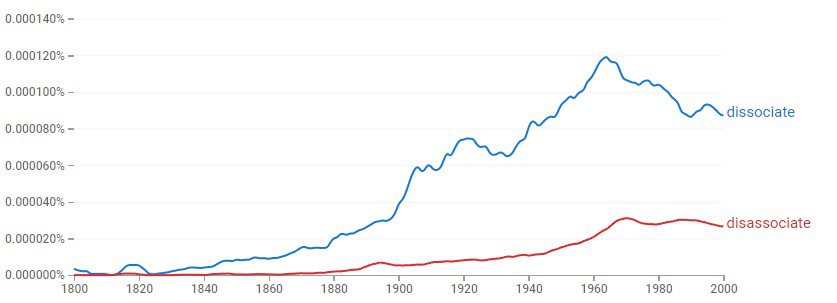
This ngram, which graphs the use of dissociate and disassociate in English-language books published from 1800 to 2019, shows that disassociate became common slightly later than dissociate but has gained ground in recent decades.

Examples
As for large edited publications, The New York Times, for instance, appears to use both dissociate and disassociate, but disassociate appears more often:
That would be this Friday, during the third round of the $8.5-million match-play tournament sponsored by the first company to disassociate itself from Woods. [NYT]
Although the technology of the cars is not the highest in the world and is not the race’s main attraction, it is impossible to dissociate the technology from the human challenge. [NYT]
The Wall Street Journal uses disassociate:
Having played so prominent a role in last October’s talks with Iran, the U.S. can’t easily disassociate itself from something broadly in line with that framework. [WSJ]
In the U.K., The Telegraph uses both words on a more or less equal basis:
The Tory brand … was so toxic that ordinary people wanted to disassociate themselves even from policies which they would otherwise approve of. [Telegraph]
After a difficult first year, the president is trying to dissociate himself from complex bills. [Telegraph]
The Guardian prefers dissociate:
Careful to dissociate himself from backward-looking nostalgia, he argued for an open and renewable sense of national identity. [Guardian]
Comments are closed.